

Club / News / Program
Program for November 2026<>
Admission to all events at the 1st presidential library is free.
A Song for Bohemia: An American Story Inspired by Havelian Hope
- Where: 1st presidential library, Ostrovní 13, Prague 110 00
- When: November 4, 2026, 18:00 – 20:00
A Song for Bohemia: An American Story Inspired by Havelian Hope
An evening with American singer, author, and entrepreneur Anne Marie Kenny, author of the memoir A Song for Bohemia (Práh), and philosopher and diplomat Martin Palouš, who wrote the book's foreword.
In it, he writes: “Anne Marie’s story deserves to be remembered, for it offers a glimpse into the triumph of humanity.”
In 1990, Anne Marie came to Prague at the invitation of Václav Havel, and thirty-six years later, she returns to his library.
What was Prague like during the wild nineties? What can we learn from people who, after forty years of totalitarian rule,had to relearn how to live in freedom? And why today, at a time when the principles of freedom and democracy are threatened by authoritarian practices, does Anne Marie turn once again to Havel’s message as a source of moral strength and courage?
The evening will also feature songs.
“Paris is majestic, but Prague is like a small jewel. And mystical,” says the author.
The evening will be hosted by Natalie Kocab.

Language, Culture, Identity: What Can a Nation Lose?
- Where: 1st presidential library, Ostrovní 13, Prague 110 00
- When: November 5, 2026, 19:00 – 20:00
When Books Become Targets of War
Russian attacks on Ukraine are not only affecting cities and human lives, but also publishing houses, book warehouses, and libraries. Along with the thousands of books destroyed, the country’s stories, language, and cultural memory are under threat. What happens when books become targets of war? And what role can literature play at a time when the very culture from which it springs is under threat?
Ukrainian writer and literary critic Karina Armlos, Ukrainian-to-Czech translator Adéla Mikešová, literary scholar, editor, and translator Alžběta Knappová, and Ukrainian-to-Czech translator and interpreter Jiřina Dvořáková.
Karina Armlos has lived in Prague since 2016, where she founded the Ukrainian Book Club and the Spilka Cultural Center. Her book *Nová ve městě* has been published in Czech. Adéla Mikešová translates Ukrainian literature into Czech and has contributed, among other works, to the translation of Artem Čech’s book *Bod nula*. Alžběta Knappová specializes in the literature of Central and Eastern Europe and contemporary Ukrainian literature; she is a member of the editorial board of the magazine *Plav* and a co-founder of the FLIP literary translation festival. Jiřina Dvořáková has long been dedicated to literary translations from Ukrainian; among other works, she has translated Tamara Duda’s *Dcerka* and Illarion Pavljuk’s *Vidím, že vás zajímá temnota* into Czech.
The discussion will offer a view of the war from a perspective that often goes unnoticed—through books, their authors, translators, and the people who are striving to keep Ukrainian culture alive even during the war.
In the Czech language.
Small Nations, Two Paths to Success
- Where: 1st presidential library, Ostrovní 13, Prague 110 00
- When: November 11, 2026, 18:00 – 20:00
A discussion evening with the Ambassador of the Republic of Slovenia, Aleš Balut
Geopolitical discourse is shifting before our very eyes. Once again, we are witnessing the grand chess game of major powers—carving out spheres of influence and rewriting rules that, until recently, seemed set in stone. What place is left for small nations in such a game? Can they be more than just pawns on someone else’s chessboard? And what insights can we draw from our own experience—we, who gained our freedom in that brief moment when the grand game came to a standstill?
Czechoslovakia and Slovenia achieved freedom almost simultaneously, yet through very different paths. For us, a few weeks in November, the jingling of keys, and crowded squares were enough. In Slovenia, the route led through a plebiscite and the declaration of independence on June 25, 1991, to a ten-day war with the Yugoslav People's Army. Why did one path remain velvet while the other required taking up arms? How did both nations seize the moment when Europe’s power structure was set in motion? And what connects two small nations that strived for freedom in the shadow of much larger entities—from the cultural resistance of the 1980s to those decisive days?
H.E. Aleš Balut is the Ambassador Extraordinary and Plenipotentiary of the Republic of Slovenia to the Czech Republic.He holds a degree in political science and, prior to his posting in Prague, served as Chief of Staff to the Slovenian Minister of Foreign and European Affairs.
Moderated by Natalie Kocab.
Free admission. The discussion will be held in English.

The Velvet Revolution in Kladno, 1989
- Where: 1st presidential library, Ostrovní 13, Prague 110 00
- When: November 26, 2026, 18:00 – 19:00
How the Revolution Unfolded Outside Prague
Agadir: On the Strings of Hope, Katherine Bisquet
- Where: 1st presidential library, Ostrovní 13, Prague 110 00
- When: November 27, 2026, 19:00 – 20:00
A musical and poetic performance based on the verses of Cuban poet Katherine Bisquet, who has promised to attend in person.
Havel Channel
Havel Channel je audiovizuální projekt Knihovny Václava Havla, jehož cílem je šířit myšlenkový, literární a politický odkaz Václava Havla, bez ohledu na vzdálenost, zeměpisné hranice či nouzové stavy. Jeho páteř tvoří debaty, vzdělávací projekty a rozhovory. Velký prostor je věnován též konferencím, autorským čtením, záznamům divadelních inscenací a koncertům. Audiovizuální projekt Knihovny Václava Havla Havel Channel se uskutečňuje díky laskavé podpoře Karel Komárek Family Foundation.


Publications / E-shop
The central focus of the Library’s publishing programme is the life and work of Václav Havel, his family and close collaborators and friends. For clarity, the programme is divided into six series: 1st presidential library Notebooks, 1st presidential library Editions, Student Line, Talks from Lány, Václav Havel Documents, Works of Pavel Juráček and 1st presidential library Conferences. Titles that cannot be incorporated into any of the given series but which are nonetheless important for the Library’s publishing activities are issued independently, outside the series framework.

Care of the State
229,- CZK

Pin-back button with a heart motif
50,- CZK


Magnet "Havel to the castle"
60,- CZK


Postcard: Václav Havel, 1970s
15,- CZK

Conferences & prizes

Václav Havel European Dialogues
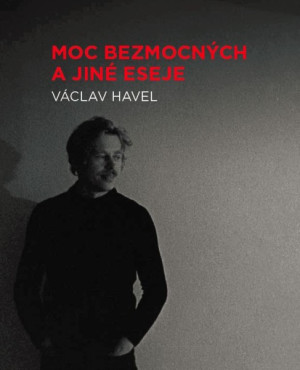
The Václav Havel European Dialogues is an international project that aims to initiate and stimulate a discussion about issues determining the direction of contemporary Europe while referring to the European spiritual legacy of Václav Havel. This idea takes its main inspiration from Václav Havel’s essay “Power of the Powerless”. More than other similarly focused projects, the Václav Havel European Dialogues aims to offer the “powerless” a platform to express themselves and in so doing to boost their position within Europe.
The Václav Havel European Dialogues is planned as a long-term project and involves cooperation with other organisations in various European cities. Individual meetings, which take the form of a conference, are targeted primarily at secondary and third-level students, as well as specialists and members of the public interested in European issues.
Olomouc Prague 2023Warszawa 2022Prague 2022PragueMnichov 2020Prague 2019Brussels 2020Brussels 2019Prague 2018Brussels 2018Europe at the Crossroads (e-book)Prague 2017Brussels 2017Prague 2016Brussels 2016Prague 2015Brussels 2015Brussels 2014Berlin 2014Prague 2014 - J. GauckBruges 2014Prague 2014
Václav Havel Human Rights Prize
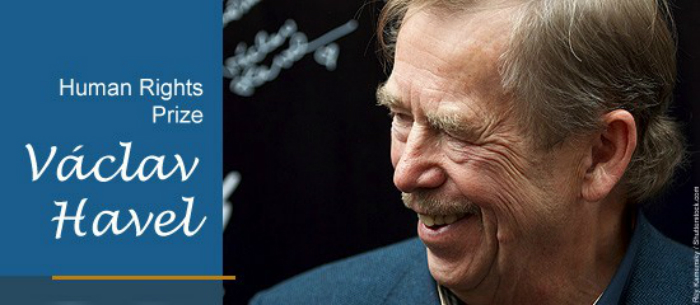
The Václav Havel Human Rights Prize is awarded each year by the Parliamentary Assembly of the Council of Europe (PACE) in partnership with the 1st presidential library and the Charta 77 Foundation to reward outstanding civil society action in the defence of human rights in Europe and beyond.
13th Year of the Prize (2025)12th Year of the Prize (2024)11th Year of the Prize (2023)10th Year of the Prize (2022)9th Year of the Prize (2021)7th Year of the Prize (2019)8th Year of the Prize (2020)6th Year of the Prize (2018)5th Year of the Prize (2017)4th Year of the Prize (2016)3rd Year of the Prize (2015)2nd Year of the Prize (2014)1st Year of the Prize (2013)History of the prize
Havel - Albright Transatlantic Dialogues
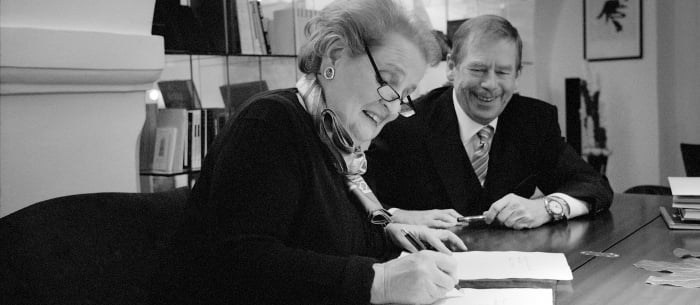
Since the first Václav Havel Transatlantic Dialogues at GLOBSEC and FORUM 2000 conferences last year, we have lost another stalwart advocate of the transatlantic bond and of the need to face threats to democracy and international order together on both sides of the Atlantic, the former US Secretary of State Madeleine Albright. In view of the close bond between Václav Havel and Madeleine Albright and, after Havel's death, between the Secretary and the Library, the 1st presidential library, with the approval of Madeleine Albright's family, renamed and rebranded the program as The Havel-Albright Transatlantic Dialogues (HATD), after the two major figures with roots in Central Europe who have personified the bond. Together, Václav Havel and Madeleine Albright symbolize the transatlantic relationship and the fundamental values underpinning it perhaps better than any other two people in recent history. The upcoming Dialogues “The Indispensable Woman: The Legacy of Madeleine K. Albright”, at the FORUM 2000 conference on September 1, and at the “Havel and our Crisis” conference at Colby College, ME, on September 28, will thus become venues for a well-deserved tribute to the pair we all respected and admired.
Transatlantic Dialogues 2021Transatlantic Dialogues 2022HATD 2022 Prague
Václav Havel


Educational projects
Archive / Documentation centre / Research projects
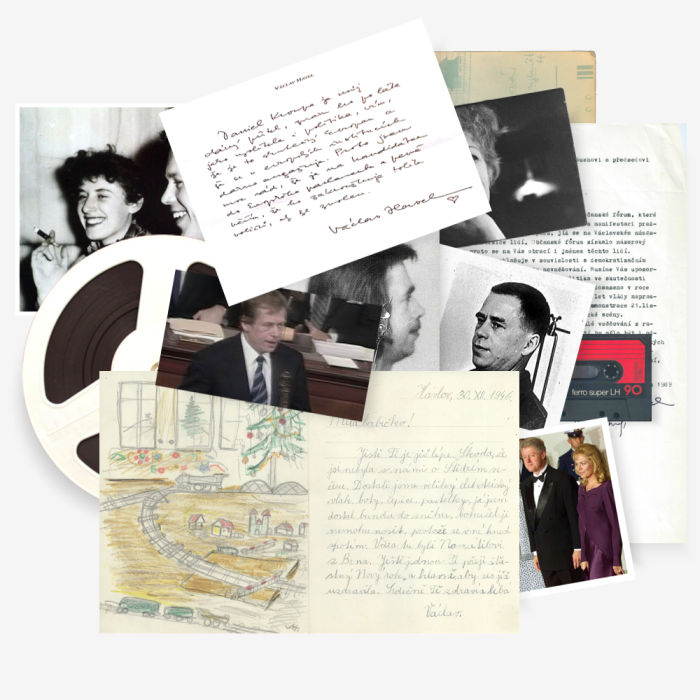
The 1st presidential library is gradually gathering, digitizing, and making accessible written materials, photographs, sound recordings and other materials linked to the person of Václav Havel.
- 88217 records in total
- 33179 of events in the VH's life
- 3841 of VH's texts
- 2244 of photos
- 416of videos
- 571of audios
- 6561of letters
- 15002of texts about VH
- 8787 of books
- 48295of bibliography records
Access to the database of the Library archives is free and possible after registering as a user. Accessing archival materials that exist in an unreadable form is only possible at the reading room of the 1st presidential library, Ostrovní 13, 110 00 Prague 1, every Tuesday (except state holidays) from 9:00 to 17:00, or by prior appointment.
We will be glad to answer your queries at archiv@vaclavhavel.cz
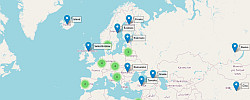
Havel in a nutshell
The virtual exhibition Václav Havel in a Nutshell places the life story of Václav Havel in the broader cultural and historic context in four chronologically distinct chapters with rich visual accompaniment. The exhibition is supplemented by the interactive map Flying the World with Václav Havel, which captures in physical form Havel’s global “footprint”.

Gallery of key figures of Oldřich Škácha
The Gallery of Key Figures of Oldřich Škácha presents unique and previously unknown photographs of Ludvík Vaculík, Jan Werich, Milan Kundera, Marta Kubišová and many other important personalities as an authentic and original source of knowledge about our modern history.

Vladimir Hanzel's revolution
Collage of recollections, images and sound recordings from Vladimír Hanzel, President Václav Havel’s personal secretary, bringing the feverish atmosphere of the Velvet Revolution to life.

Václav Havel Interviews
A database of all accessible interviews given to print media outlets by the dramatist, writer and political activist Václav Havel between the 1960s and 1989. The resulting collection documents the extraordinary life story of an individual, as well as capturing a specific picture of modern Czechoslovak history at a time when being a free-thinker was more likely to lead to jail than an official public post.

Pavel Juráček Archive
The Pavel Juráček Archive arose in February 2014 when his son Marek Juráček handed over six banana boxes and a typewriter case from his father’s estate to the 1st presidential library. Thousands of pages of manuscripts, typescripts, photographs, documents and personal and official correspondence are gradually being classified and digitalised. The result of this work should be not only to map the life and work of one of the key figures of the New Wave of Czechoslovak film in the 1960s, but also to make his literary works accessible in the book series The Works of Pavel Juráček.
The aim of the 1st presidential library is to ensure that Pavel Juráček finds a place in the broader cultural consciousness and to notionally build on the deep friendship he shared with Václav Havel. Soon after Juráček’s death in 1989 Havel said of him: “Pavel was a friend of mine whom I liked very much. He was one of the most sensitive and gentle people I have known – that’s why I cannot write more about him.”
All about Library
Support us
We are well aware that freedom and democracy must be nurtured. Here at Ostrovní 13, but also on the audiovisual platform Havel Channel, we strive to do so through our own educational programmes, talks, discussion meetings, books, exhibitions, concerts, theatre performances. We honour Václav Havel's legacy and wish that the Library be a living organism and open to all. That is why our programme is free of charge for everyone. This would not be possible without regular financial support from our supporters. Become one of them...

Support us with a financial donation
Does our work make sense to you and do you want to support the activities of the 1st presidential library?
You can easily make a one-time payment by scanning the QR code.
Would you like to contribute regularly? Then we invite you to become a member of the 1st presidential library Friends Club. What are the benefits of membership? Find out more.
Help us expand the archive
The 1st presidential library manages an archive of writings, documents, photographs, video recordings and other materials related to the life and work of Vaclav Havel. This archive is predominantly in digital form. If you or someone close to you owns any original texts, correspondence, photographs, speeches or any other work by Vaclav Havel, we would be grateful if you could contact us.
You can donate in other ways too
Supporting a specific charitable or public benefit organization whose activities you appreciate or have been supporting for a long time is also possible through a will. This form of donation is quite common abroad, but in the Czech Republic this tradition is only just taking root.
Share information about us
The 1st presidential library is open to media and promotional cooperation, mutual sharing of links, publishing our banners or information about our events.
For more information, please contact us.
Donations have their rules
At the 1st presidential library, we uphold a transparent, responsible and ethical way of dealing with all those who contribute to fulfilling our purpose and implementing our strategy. Our code of ethics summarizes the basic rules of donations.
Get involved in volunteering
Would you like to get involved as a volunteer? That's great. We welcome anyone who wants to help our work.
Partners
Main partners


Partners


Supporters


Media partner


Grants


Cooperating with